
The Dignity of workers in an age of articial intelligence - Sam corcoran
Earlier this year CPW member Sam Corcoran attended a conference near Rome on the subject of Artificial Intelligence. His experience fed into the contents of the CPW he chaired this summer at Kintbury, so we asked him to tell us more.
CPW will return to the topic of work and artificial intelligence at the all-age week next Summer, to be chaired by Louise Cook, 31 July - 6 August at Kintbury in Berkshire.
At the end of May I attended a conference at Palazzola near Rome organised through the Catholic Social Action Network to discuss the dignity of workers in an age of Artificial Intelligence. The conference involved discussion of the newly published document on the Grandeur of Humanity by Pope Leo XIV.
There are 3 things that struck me during the conference:
1) Palazzola was the summer retreat of students at the English College in Rome and it is a stunningly beautiful setting looking over Lake Albano to Castel Gandolfo, the Pope’s residence on the far side of the lake. A Pope is alleged to have visited Palazzola and said “Typical of the English to look down on the Pope”
2) We were visited by the British Ambassador to the Holy See who spoke about the truly historic visit of King Charles III to Rome. The last British monarch to have prayed with the Pope in Rome is King Macbeth (which suggests Shakespeare was somewhat biased in his portrayal) and the last English Monarch is King Cnut.
3) We also visited the offices of the Dicastery for the Promotion of Integral Human Development. What struck me was how similar the offices were to any other civil service office; the Dicastery is the Vatican equivalent of a British Ministry. The Vatican provides excellent resources for promoting the work of the Catholic Church, including graphics for use in social media and all available at www.vatican.va or https://www.humandevelopment.va/en/magnifica-humanitas/risorse.html
During the week there was much discussion about the future impact of AI, which was described as a freight train coming down the tracks. It is clear that it will take over the work of many ‘white collar’ jobs such as accountants and lawyers. One of the youth delegates responded that the freight train has already arrived with 1 million unemployed recent graduates. From my own profession I know that accountancy firms are drastically reducing their intake of new graduates. I spent much time thinking over whether we need to design a society so that everyone has work or have a Universal Basic Income so that everyone is supported whether they have a job or not - I still do not have a clear answer.
When Robert Prevost was appointed Pope in May 2025 I suggested that he had chosen the name Pope Leo XIV as he wished to follow Pope Leo XIII who wrote about the impact of the industrial revolution on workers. In 1891 Pope Leo XIII in Rerum Novarum wrote about ‘grasping employers’ and how ‘a small number of very rich men have been able to lay upon the teeming masses of the labouring poor a yoke little better than that of slavery itself’. He promoted the nascent trade union movement as a way of addressing the power imbalance between workers and employers.
In 2026 Pope Leo XIV has written in Magnifica Humanitas how we again have huge disparities in wealth with a small number of very rich men who control digital platforms able to “present a particular vision of reality as desirable”. On social media “control is exercised not only through explicit prohibitions, but also through the architecture of visibility: what is amplified or rendered invisible, what is rewarded or penalized, ultimately shapes opinions and choices, fostering conformity and self-censorship”. The human person is treated “as an object to be manipulated or a resource to be optimized”.
To counter the misinformation and manipulation on social media the Pope calls for “serious journalism and forums for debate, where reasoned argumentation and verification carry greater weight than immediate reaction.”
Three aspects of AI are highlighted:
1. the ease with which results are obtained
2. the impression of objectivity and
3. the simulation of human communication
On the first point the Pope recognises that Artificial Intelligence does produce quick answers and is a ‘valuable tool that requires vigilance’. However, one of the perils of AI is that its speed in providing ready-made answers can encourage excessive reliance and weaken personal creativity and judgment. In extremes some people may gradually lose the very desire to form genuine human connections.
On the second point, AI is not morally neutral. In reality, every technical tool embodies choices and priorities through what it measures, ignores and optimizes. AI systems reflect and reinforce the stereotypes or ideological bias of their designers and developers. The exclusion of the vulnerable becomes cloaked in a veneer of neutrality and objectivity. What is needed is a more active political involvement in controlling the use of AI, with data as a common good and better regulation.
On the third point, whilst AI can mimic human communication it cannot provide the very essence of our humanity, namely the capacity for relationship and love.
Although the challenges of AI may seem huge we can start at a very local level with the way we behave towards others on social media. The Pope talks of ‘digital sobriety’. We are asked not to say about your neighbour the things you would not want said about yourself. Digital sobriety requires truth, moderation, closeness and care. We can prefer what is right despite the most appealing content and pursue wisdom rather than immediate results.
The Pope quotes Gandalf from The Lord of the Rings ”It is not our part to master all the tides of the world, but to do what is in us for the succour of those years wherein we are set, uprooting the evil in the fields that we know, so that those who live after may have clean earth to till.”
There are those who seek to use new technologies to create an enhanced and almost disembodied humanity. In response to those men who wish to become gods, the Pope recalls that Christians believe in a God who became man. The mystery of the Son of God entering into our human condition as a baby Jesus promises something quite different. Jesus Christ descends into our history in order to free us from all forms of slavery. He takes upon himself our weakness and transforms it into a setting for salvation.
The “grandeur of humanity” shines in every authentically human achievement.
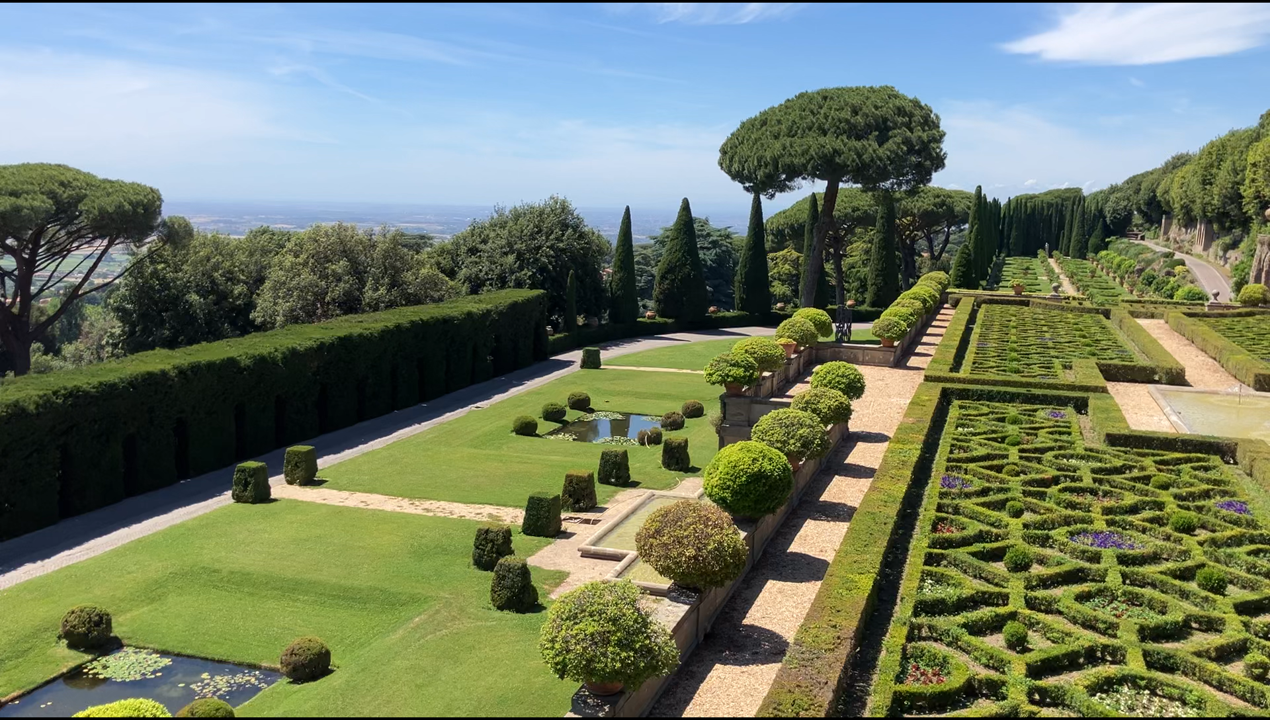
Papal Gardens at Castel Gandolfo
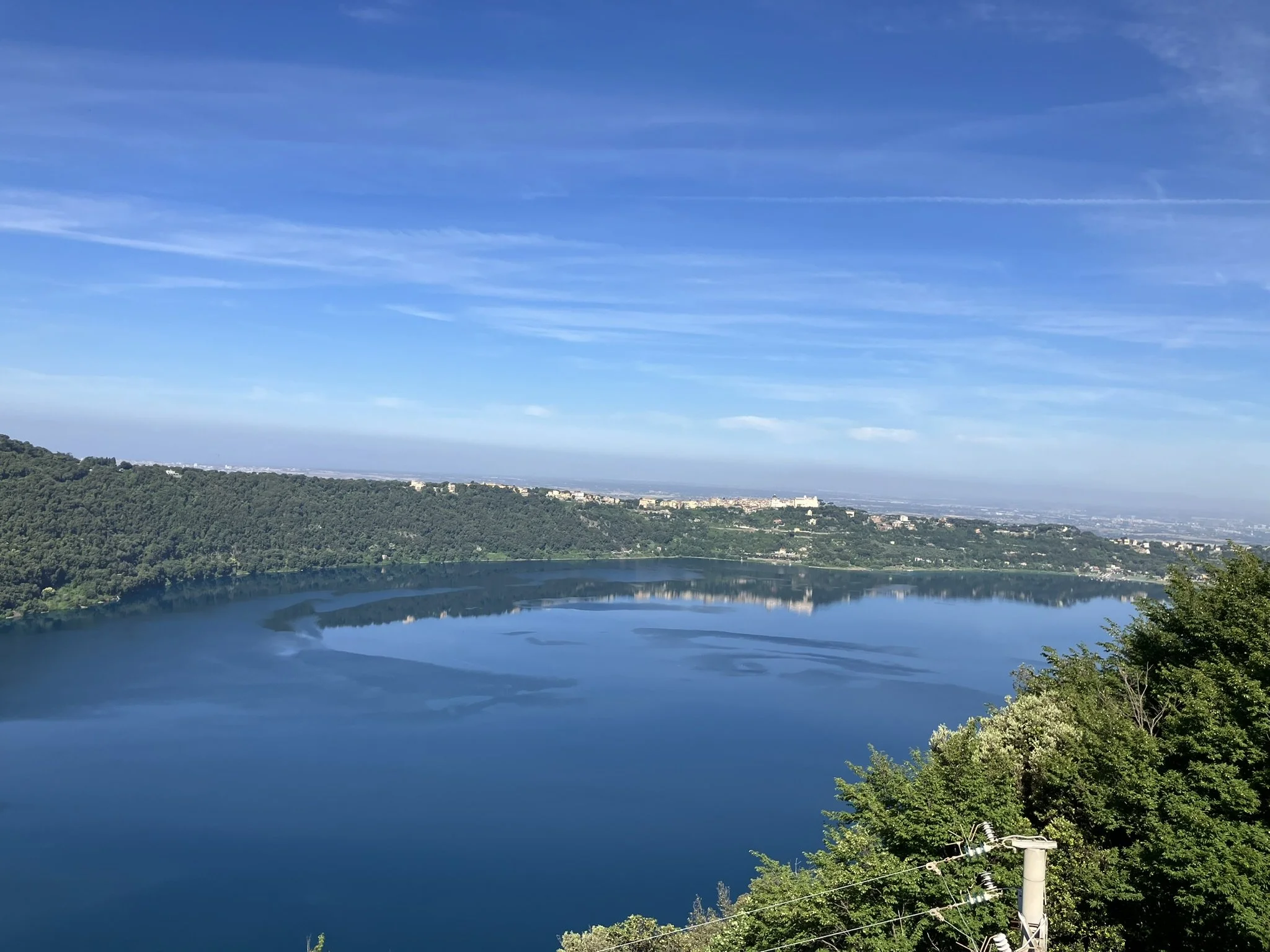
View of Castel Gandolfo from Palazzola